BSL / SSL
Definition
BSL and SSL are two specific forms of liquidity, named after which side of the market they "help" during a sweep:
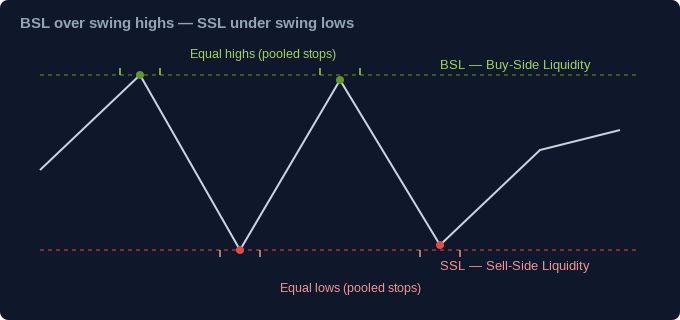
- BSL — Buy-Side Liquidity: sits above clear swing highs. It consists of stop loss orders from short positions (which trigger a buy order when hit) as well as breakout buy orders from traders expecting a break upwards
- SSL — Sell-Side Liquidity: sits below clear swing lows. It consists of stop loss orders from long positions (which trigger a sell order when hit) as well as breakout sell orders from traders expecting a break downwards
Why the names make sense
The names refer to the direction the order flow points when the level is hit — not to whether price itself rises or falls to get there:
- When BSL is hit (price rises above a swing high), a wave of buy orders is triggered — which in itself can briefly push price further up before a possible reversal
- When SSL is hit (price falls below a swing low), a wave of sell orders is triggered — which briefly pushes price further down
How do you identify BSL/SSL on a chart?
- Identify clear, well-defined swing highs (for BSL) and swing lows (for SSL) — see HH, HL, LH, LL
- The more times a level has been tested without being broken, the more liquidity is typically assumed to have piled up around it — more traders have had the chance to place a stop loss exactly there
- Equal highs/lows (several swing points lying very close to the same level) are an especially strong sign of concentrated liquidity — they signal that many traders have probably placed their stop loss around exactly this level
BSL/SSL in practice — how it is used in an analysis sequence
A typical pattern combining several of this site's concepts:
- Price forms a clear SSL (a swing low, possibly tested several times)
- Price sweeps down through the SSL — triggering the sell orders that sat there (see Liquidity sweep)
- Price reverses quickly and then breaks up through a previous swing high — a CHoCH if it goes against the previous trend, or a BOS if it confirms it
- This typically leaves an FVG or a Buy Zone in the new direction, which can be used as a concrete entry area
Why BSL/SSL is more reliable than random levels
Because these levels are defined by where other market participants' orders actually sit (based on ordinary, predictable risk management behaviour — placing a stop loss around clear swing points), they are far more meaningful than arbitrarily chosen support/resistance levels. It is exactly this predictability in retail behaviour that institutions can (and, according to Smart Money theory, often do) exploit structurally.
Summary
BSL and SSL are the two types of liquidity pool, sitting above swing highs and below swing lows respectively — defined by the type of order flow triggered when they are hit. Being able to identify them consistently is a precondition for understanding why price often moves the way it does just before a real, directional move begins.
See also: Liquidity · BOS · CHoCH · HH, HL, LH, LL