Liquidity
What is liquidity in this context?
As introduced in Market mechanics, liquidity means the amount of orders available around a price level. In a Smart Money context the term is used more specifically: liquidity is the places on a chart where a concentrated pool of stop loss orders sits, which institutions can "seek out" to get their own large orders filled efficiently (see How do institutions trade?).
Where does liquidity typically sit?
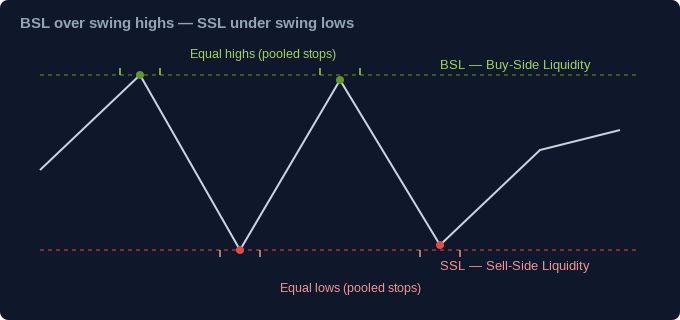
Liquidity typically collects just above clear swing highs and just below clear swing lows — exactly where ordinary retail traders place their stop loss orders:
- A trader who is long (has bought) typically places the stop loss some way below a nearby swing low. If it is hit, a sell order is triggered — this is what makes up SSL (Sell-Side Liquidity)
- A trader who is short (has sold) typically places the stop loss some way above a nearby swing high. If it is hit, a buy order is triggered — this is what makes up BSL (Buy-Side Liquidity)
See BSL/SSL for a full walkthrough of these two concepts.
Why is liquidity attractive to large players?
Because these levels concentrate a large number of opposite orders in one place, they let institutions fill a significant part of a large order at a relatively good average price, without having to "eat" their way slowly through thinner parts of the order book (see market impact in Market mechanics).
Liquidity sweep — when price "seeks out" these levels
A liquidity sweep (also called a "stop hunt" or "liquidity grab") is when price moves briefly through a level with concentrated liquidity, triggers the stop loss orders piled up there, and then reverses relatively quickly in the opposite direction.
This is one of the most recognisable and widely used patterns in Smart Money analysis, because it often marks the point where an institution has had a significant part of its order filled and the real, intended move can begin. See the combined example with a subsequent CHoCH on Signs of institutional influence.
How is liquidity used actively in analysis?
- Identify where liquidity is likely to sit — clear swing highs/lows, especially those that have been "tested" several times without being broken (the more times a level has been respected, the more liquidity is assumed to have piled up there)
- Wait for a sweep of this level — a brief move through the level
- Confirm with structure — look for a subsequent BOS or CHoCH in the opposite direction of the sweep, which confirms that the move was real and not just noise
- Use this as context for a possible entry, often in combination with an FVG or a Buy Zone/Sell Zone formed in the subsequent move
An important clarification
Not every move through an earlier swing point is a real, institutionally driven liquidity sweep — sometimes it is simply a real BOS (a continued trend), and price just carries on in the same direction. The difference lies in what happens afterwards: a genuine sweep is typically followed by a relatively quick reversal, while a real structure break is not. This is exactly why it is recommended to require confirming signals (see Signs of institutional influence) instead of trading an isolated sweep on its own.
Summary
Liquidity is the core concept that ties large parts of Smart Money analysis together: it explains why price often moves against the expected direction before the real move begins, and it gives a concrete, recognisable place to look for institutionally driven setups. The next sections — BSL/SSL, BOS and CHoCH — build directly on this understanding.
See also: BSL/SSL · BOS · CHoCH · How do institutions trade?