Trends
What is a trend?
A trend is the market's overall direction over a given period. Understanding the trend is fundamental, because most profitable strategies — especially within Smart Money concepts — are built on trading with the dominant direction instead of against it.
The market never moves in a straight line. Instead it moves in a series of up and down swings, and the overall direction of those swings defines the trend.
The three types of trend
| Trend | Characteristics |
|---|---|
| Up (bullish) | Price forms a series of Higher Highs (HH) and Higher Lows (HL) — see the section on HH/HL/LH/LL |
| Down (bearish) | Price forms a series of Lower Highs (LH) and Lower Lows (LL) |
| Sideways (ranging/consolidation) | Price moves between a defined ceiling and floor without a clear direction — neither an HH/HL nor an LH/LL pattern is clear |
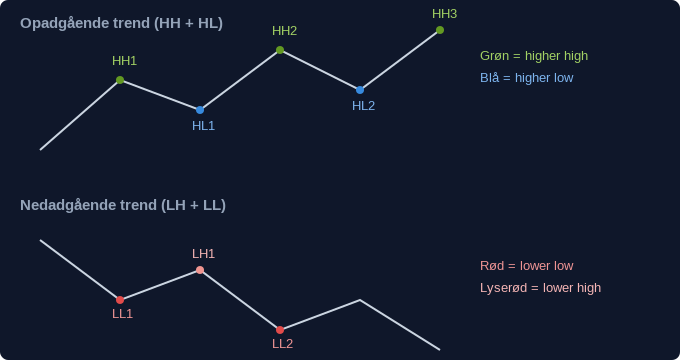
How do you identify a trend?
The most basic way to read a trend is through structure — the pattern of swing highs and swing lows on the chart (see the HH/HL/LH/LL section for a detailed walkthrough). As soon as this structure breaks significantly (e.g. through a CHoCH or a BOS — see those sections), it can signal a potential trend change.
A trend depends on the timeframe
One of the most important points to understand: a trend always exists relative to a specific timeframe. The market can be in an uptrend on D1 while it is in a downtrend on M15 (a so-called "correction" or "pullback" within the larger trend).
That is exactly why top-down analysis (see the section on Timeframes) is so central: you need to know which trend you are actually dealing with before you trade.
Trend continuation vs. trend reversal
- Trend continuation: Price makes a temporary correction (pullback) and then continues in the original direction. Most Smart Money setups (FVG, Buy/Sell Zones) are typically used to "buy" pullbacks in an uptrend or "sell" pullbacks in a downtrend
- Trend reversal: The underlying structure really changes character — this is exactly what a CHoCH (Change of Character) identifies (see that section)
Why trade with the trend?
Statistically it is much easier to find profitable setups when you trade in the direction of the dominant, institutional flow of capital than when you try to "catch tops and bottoms" against the trend — a technique that requires far more precision and typically gives inexperienced traders a worse risk/reward profile.
"The trend is your friend" is one of the oldest sayings in trading — and it still holds, because institutional capital typically moves the market in sustained directions over time rather than at random.
Summary
The trend is the foundation everything else is built on. Without a clear understanding of the overall direction — and of the timeframe it applies to — even the most advanced Smart Money concepts become hard to use correctly.
Previous page: Timeframes Next page: Bias