Risk/reward
What is risk/reward?
Risk/reward (R:R) is the ratio between how much you risk on a trade and how much you can potentially earn if it hits its target. It is usually given as a ratio, e.g. 1:2, which means you risk 1 unit for the chance to earn 2.
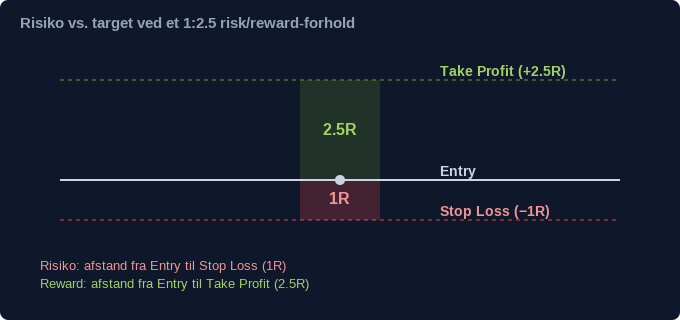
Why R:R alone doesn't tell the whole story
A common misunderstanding is to think that a higher R:R is automatically "better". The reality is that R:R has to be seen together with the win rate — it is the combination that decides whether a strategy is really profitable. See Risk management for the full formula.
Example: the same strategy, two ways of looking at it
| R:R | Win rate needed to break even |
|---|---|
| 1:1 | 50% |
| 1:2 | 33.3% |
| 1:3 | 25% |
| 1:0.5 | 66.7% |
This means a strategy with an R:R of 1:3 can still be profitable even if it only wins one trade in four — while a strategy at 1:1 requires you to win more than half the time just to break even (before costs).
How is this used in practice?
- Define your target BEFORE you open a trade — not along the way, based on how you "feel" price is moving
- Know your R:R before you press "buy/sell" — if the ratio doesn't meet your own minimum (many use a rule of thumb of at least 1:1.5-1:2), the trade may not be worth taking, even if the setup otherwise looks fine
- Use structure to set realistic targets — in a Smart Money context the next relevant liquidity level is typically used as the target, not an arbitrary number of pips
The link to win rate — why it is a trade-off
There is often a natural trade-off between R:R and win rate: the more ambitious a target you set (higher R:R), the less often price typically gets all the way there before turning (lower win rate). Conversely, a closer, more conservative target (lower R:R) often gives a higher win rate, but requires more winning trades to make up for the losses.
There is no single "correct" R:R — it depends on your strategy and should be determined through thorough backtesting of what actually works for your particular setup, rather than an arbitrary rule.
A common mistake: moving the target along the way
A frequent psychological pitfall (see Psychology) is changing your target while a trade is open — either by taking profit too early out of fear (which cuts your real R:R well below the planned one), or by greedily pushing back a target already reached in the hope of more. Both undermine the statistical edge your strategy was tested to have, because your real behaviour no longer matches what you backtested.
Summary
Risk/reward describes the ratio between potential profit and risk on a single trade, but it only means something together with your win rate. A lower win rate can easily be profitable with a high enough R:R, and vice versa. The most important thing is to define your target before the trade is opened and stick to it — not to let emotions in the moment change a plan that was already tested and thought through.
See also: Risk management · Position sizing · Backtesting · Psychology