Risk management
Why risk management matters more than your strategy
This is probably the most important category on the whole site, and that is not an exaggeration. As mentioned several times already (see Can you make a living from trading? and Discipline): a mediocre strategy with strict risk management can survive and improve over time. An excellent strategy without risk management will sooner or later blow up an account — it is not a question of if, but when.
This category covers the concrete, practical tools: Position sizing, Risk/reward, Max daily/weekly loss and Stop loss placement.
The three questions risk management answers
Before every trade you should be able to answer clearly:
- How much am I risking on this single trade? → Position sizing
- Is the potential profit large enough relative to the risk? → Risk/reward
- When do I stop trading for today/this week, whatever happens? → Max daily/weekly loss
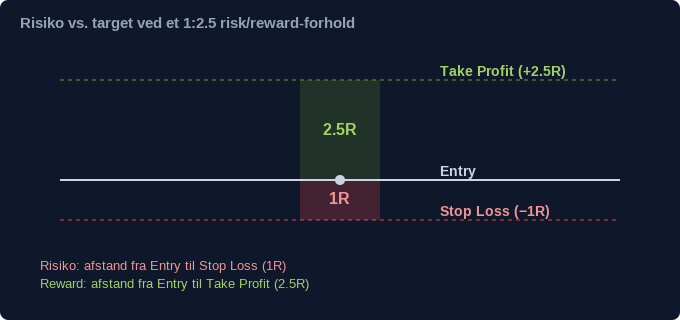
The basic mathematical principle
Trading is a game of probabilities, not a question of being right every time. What decides whether a strategy is profitable over time is the combination of win rate (how often you win) and average risk/reward (how much you win relative to what you risk):
Expected value = (Win rate × Average win) − (Loss rate × Average loss)
This means that a strategy that only wins 40% of the time can easily be profitable if the winning trades are on average much larger than the losing ones — and conversely, a strategy with a 70% win rate can lose money if the losses, when they happen, are disproportionately large. This is exactly why Risk/reward and Position sizing are inseparable.
Risk management is not just maths — it is also psychology
Even the mathematically most optimal risk management only works if you can actually follow it. See Psychology, Overtrading, Revenge trading and Martingale for how risk management is often broken in practice — not because people don't know better, but because emotions in the moment override the plan they made in peace and quiet.
Summary
Risk management is what decides whether you survive long enough for your strategy and your discipline to show their real value over time. The following pages go through each of the concrete building blocks — position sizing, risk/reward, loss limits and stop loss — which together make up a complete risk management plan.
See also: Position sizing · Risk/reward · Max daily/weekly loss · Stop loss placement