FVG (Fair Value Gap)
Definition
A Fair Value Gap (FVG) is a price imbalance that appears when the market moves so strongly and fast in one direction that it leaves a "hole" in the price structure — an area where there wasn't enough two-way trading (both buyers and sellers active) to establish a "fair" price.
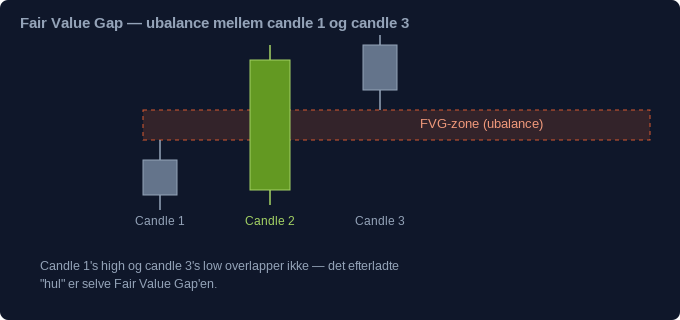
The concept is typically identified from three consecutive candles:
- Candle 1: an ordinary candle
- Candle 2: a large, impulsive candle in one direction
- Candle 3: a candle whose low (for a bullish FVG) or high (for a bearish FVG) doesn't overlap with candle 1's range
The "hole" that appears between candle 1's high and candle 3's low (for a bullish FVG) is the FVG itself.
Why does an FVG appear?
An FVG is typically the result of a large, institutional order being filled so aggressively that it "skips" normal price levels in its hurry to get the order through (see market impact in Market mechanics). Because not all price levels in this move were "tested" by two-way trading, they are seen as an imbalance the market often (but not always) returns to "fill" later.
How is an FVG used as an entry zone?
The basic idea in the Smart Money approach is that price often returns to an FVG to "revisit" this imbalanced area before continuing in its original direction — which gives a concrete, defined place to consider an entry:
- Identify an FVG formed in the direction of your bias — typically after a BOS or CHoCH
- Wait for price to move back into the FVG zone
- Look for further confirmation on a lower timeframe (see Timeframes) — e.g. a smaller CHoCH inside the zone itself
- Use the zone's boundaries to define a precise stop loss (typically just outside the FVG) and entry level
FVG vs. ordinary support/resistance
What separates an FVG from a traditional support/resistance line is that it is defined by a specific, measurable imbalance in the price structure itself (based on three concrete candles), not just a level where price "has reacted before". This makes it more objective and easier to identify consistently across different traders.
Not all FVGs are equally relevant
- FVGs formed in the direction of the overall trend (see Trends) are generally considered more reliable than those going against it
- FVGs formed after a liquidity sweep (see Liquidity) — that is, in the "fresh" move that follows an institutional collection of liquidity — are often weighted higher than isolated FVGs without this context
- An FVG that has already been "visited" and partly filled once is typically considered weaker on a second test
Summary
An FVG is a concrete, measurable price imbalance formed by three candles, which the market often returns to revisit. It is mainly used as a precise, defined area to look for entries in, especially when it appears together with BOS/CHoCH and liquidity — the combination behind the Unicorn model, which this site covers next.
See also: Buy Zone/Sell Zone · Unicorn · Liquidity · CHoCH