Trading sessions
What is a trading session?
The FX market is open 24 hours a day, 5 days a week — but that doesn't mean activity is the same all the time. The market is divided into sessions that follow when the major financial centres around the world are open. When a financial centre opens, activity and liquidity rise sharply in the pairs most relevant to that region.
The four main sessions are Sydney, Tokyo (Asia), London and New York, and they partly overlap over the day.
The four sessions (in Danish time, CET, winter — see the note below)
| Session | Hours (Danish time, approx.) | Characteristics |
|---|---|---|
| Sydney | 23:00 - 08:00 | The market's "opening" for the day, generally lower volume |
| Tokyo (Asia) | 01:00 - 10:00 | Focus on JPY pairs, often calmer and rangebound trading |
| London | 09:00 - 18:00 | The most active session — the highest volume of the whole day |
| New York | 14:30 - 23:00 | The second most active session, strongly influenced by US news |
Important: These times shift with summer/winter time in both Europe and the US, and the two don't necessarily change at the same time. Always check the current session times around the changeovers between summer and winter time instead of counting on fixed clock times all year round.
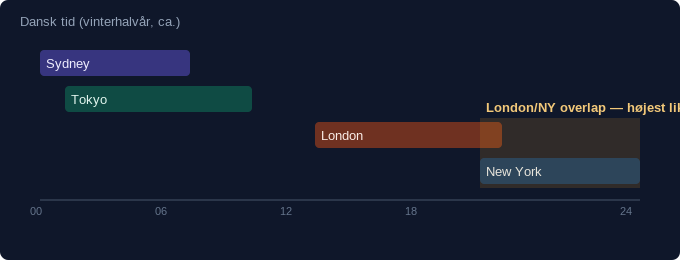
Session overlaps — where it really happens
The most crucial thing to understand is the overlaps between sessions, where two financial centres are open at the same time:
London/New York overlap (about 14:30-18:00 Danish time)
This is the most liquid and volatile period of the whole day. The world's two largest financial centres are active at the same time, which creates much higher volume, tighter spreads and often the strongest, "cleanest" moves of the day. Most day traders who focus on FX majors concentrate most of their activity here.
Tokyo/London overlap (about 09:00-10:00 Danish time)
A smaller but still relevant overlap, especially for pairs involving JPY.
Characteristics by session
Sydney/Tokyo (the Asian session)
- Generally lower volatility and volume compared with London/New York
- Often marked by rangebound (sideways) movement, especially on majors that don't involve JPY
- Can be relevant for traders who focus specifically on Asian pairs, or who use the low volatility to identify a range price can later break out of (see Market mechanics and Liquidity)
The London session
- The highest volume of the four sessions — London accounts for a significant part of total global FX turnover
- Often where the day's first big directional move (BOS/CHoCH) happens, after a period of the Asian session's typically more limited trading
- Many Smart Money-based setups specifically take their starting point in the structure formed around the London open
The New York session
- The second most active session, with high volatility especially around US news releases (rate decisions, employment figures such as NFP, inflation figures)
- The overlap with London (the first hours of the New York session) is typically the most traded period of the day
Why does the session matter for your strategy?
- Liquidity affects spread and execution — especially relevant for scalping, where even small differences in spread matter a lot
- Volatility affects whether there is "enough movement" to trade meaningfully at all — see Volatility
- Institutional activity is typically concentrated in certain windows — many of the Smart Money concepts this site covers (liquidity sweeps, BOS, CHoCH) occur more often and more reliably during London and New York than during the calmer Asian session
- Your own time zone and availability decide in practice which sessions you can trade consistently at all — see the next page, The best times to trade, for more on how to choose your main trading windows
Summary
Trading sessions decide when the market really "lives" — and the London/New York overlap is where most day traders focused on FX majors should concentrate most of their attention. Understanding the session structure is a fundamental layer on top of the timeframe and trend understanding from earlier pages, because it tells you when during the day your setups are likely to be most reliable.
See also: The best times to trade · Volatility · Scalping